Published by HarperCollins, July 2025
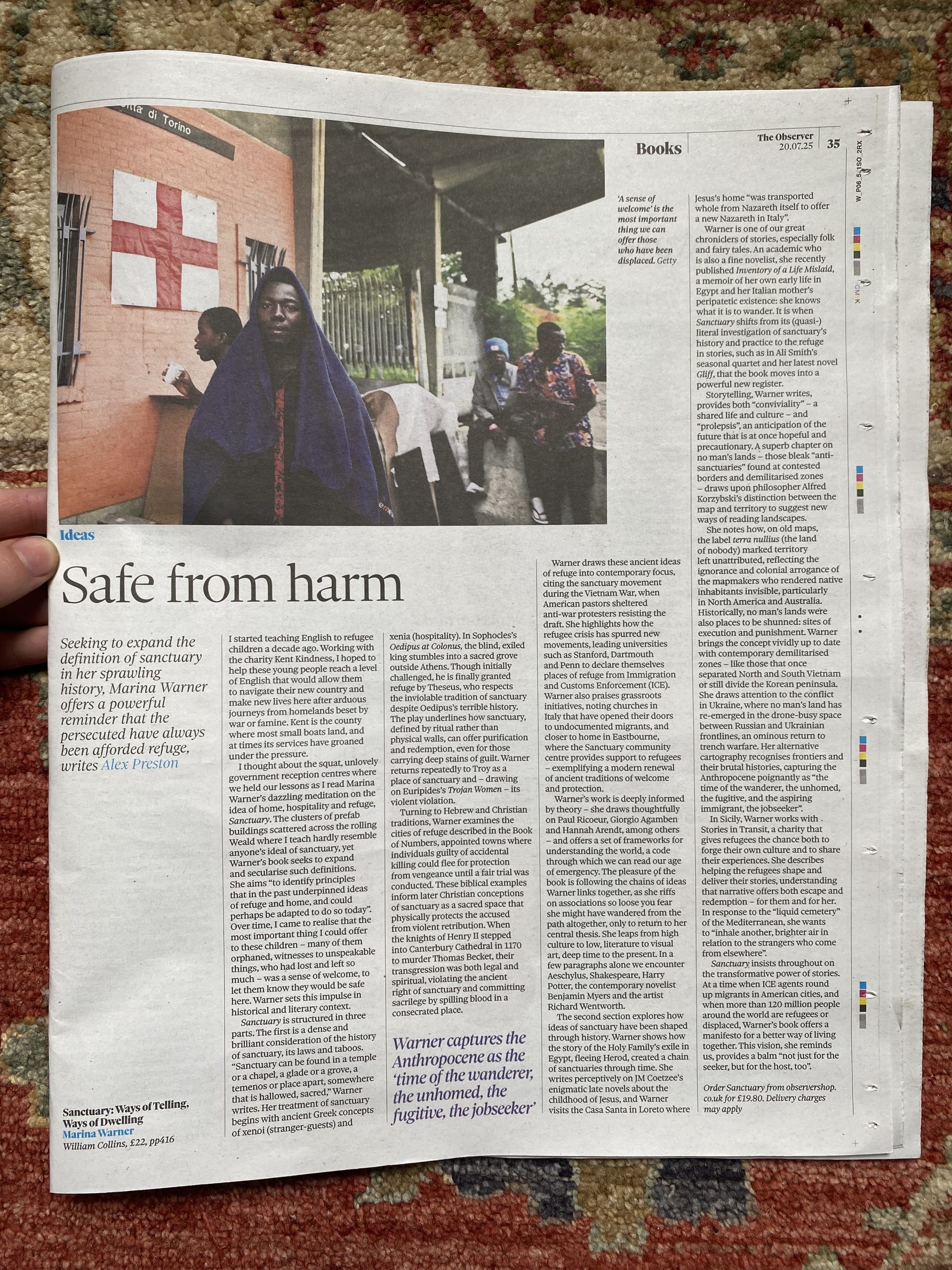
Sanctuary is an ancient right– a haven, a place of refuge and freedom from harm. In the classical world, it offered immunity to fugitives from justice; in medieval Europe it extended a reprieve to all who sought sanctuary in a church or holy site. It was a sacrilege to lay hands on a sanctuary-seeker : sanctuary was sacred.
But what are the principles that govern this ancient tradition? Could a revived practice of sanctuary today offer security, a home for those who seek it? What could ‘sanctuary’ offer to those who have been displaced? Or does the idea support excluding those of a certain race or creed?
Increasingly, in keeping with the general growth of nationalism and individualism, the arc of the concept has been bending away from a place of openness and welcome towards a private safe place, a redoubt : home and homeland as sanctuaries to be defended against strangers, migrants, incomers.
In this groundbreaking book, the distinguished cultural historian Marina Warner explores the principles that underpin the tradition of ‘sanctuary’. She ranges broadly across myth and history and explores the concept of hospitality, the cult of relics, shrines and festivals, the imagination of place, and travelling tales. She asks profound questions about political ideas of a right to safety, home, freedom of movement, and peace.
Sanctuary was written alongside work with the project Stories in Transit, which brings young refugees together with artists, writers and musicians in the UK and in Sicily to invent or reimagine stories and perform them. Marina Warner reflects on the ways stories address the worst experiences of humanity, and argues that the act of storytelling offers a salve, a route to a site of mutual interaction and understanding, a new place of belonging and conviviality. The book draws on a lifetime of engagement with literature, myth, history and tradition from different cultures. It is an ambitious attempt to grapple with the sharpest questions that we are facing in a world of global turmoil. Warner’s inquiry could not be more relevant.
The Shelter of Stories: Ways of Telling, Ways of Dwelling exhibition on at Compton Verney (25 October 2025 – 22 February 2026) is an expansion of many of the ideas in Sanctuary. An accompanying catalogue for the exhibition is here, and available to purchase at the gift shop on site and online.
Reviews/ Press
‘dazzlingly protean book’, ‘exquisitely attuned’ – Kathryn Hughes, ‘Sanctuary by Marina Warner review – the power of stories in an age of migration’, The Guardian Book of the Day, 17 June 2025; in print on Saturday 21 June 2025

June 23 2025: BBC Radio 4: Start the Week – Sanctuary, refuge and exile
Sanctuary is an ancient idea of a place of refuge or freedom from harm. It has deep roots in the history, literature and myths of many cultures. Marina Warner’s new book Sanctuary explores travelling tales and concepts of hospitality and home – suggesting that myths, stories and works of art can be places of sanctuary too. The story of leprosy is a story of isolation and exclusion over thousands of years. In his book, Outcast, Oliver Basciano has written about his journey across the hinterlands of the world to demystify the lives of those who have been ostracised. He argues that the image we still hold onto of medieval leprosy is a nineteenth-century myth invented to justify the gross mistreatment of patients in the name of colonial, religious and economic exploitation. Churches are a spiritual home for some 200 million Christians worldwide, but they often hold a fascination and interest for the most committed atheist. A church is a place of sanctuary, but also a place where the drama of life is played out. Fergus Butler-Gallie is an Anglican priest and his new book Twelve Churches explores the history of Christianity through the places worshippers have built.
Presenter: Tom Sutcliffe Producer: Ruth Watts
Listen back here
June 29 2025 – Scotland on Sunday, Stuart Kelly
‘ingenious and meticulous’; Stories in Transit ‘might seem modest, but given how shrill and vituperative the voices ranged against displaced people are it seems all the more necessary’; ‘Part of the exhilaration of reading any work by Warner is the breadth of reference. It is the opposite of dilettantism, a purposeful, sharp stitching’ – Stuart Kelly Review, The Scotsman: Scotland on Sunday
‘[Sanctuary] documents a tight web of practices and ideals without which any culture is not only impoverished but also seriously damaged. Warner’s complex, cumulative engagement with the topic becomes itself a kind of migrant journey to whose rhythms the reader has to surrender.’; ‘The chapters on the ways in which stories create and re-create maps for our journeys through life are tantalising. They feel like short books in themselves, full of insights that demand long pondering.’; ‘This is a deeply engaging book, learned and sensitive, original, spare and strange.’ – Rowan Williams, ‘Scattered Stories’, Review for Literary Review July 2025
The Sanctuary of Stories
July 1 2025 – Literary Review, Rowan Williams
‘[Sanctuary] documents a tight web of practices and ideals without which any culture is not only impoverished but also seriously damaged. Warner’s complex, cumulative engagement with the topic becomes itself a kind of migrant journey to whose rhythms the reader has to surrender.’; ‘The chapters on the ways in which stories create and re-create maps for our journeys through life are tantalising. They feel like short books in themselves, full of insights that demand long pondering.’; ‘This is a deeply engaging book, learned and sensitive, original, spare and strange.’ – Rowan Williams, ‘Scattered Stories’, Review for Literary Review July 2025
July 5 2025 – Daily Telegraph, Rupert Christiansen
‘Sanctuary is without a doubt an imaginative and meticulous work of scholarship, underpinned by Warner’s passionately sincere commitment to the issues she raises.’; ‘rich food for thought’ – Rupert Christiansen, ‘The history of sanctuary is no safe haven’, The Daily Telegraph – Saturday
July 11 2025: ‘A Place of One’s Own – Marina Warner on how we forgot the meaning of sanctuary’, Financial Times Weekend (summer arts special)
Read online or below Kitty Grady’s interview with Marina for the FT Weekend magazine, where they discuss Sanctuary

July 19 2025 – ‘How the current treatment of asylum seekers wastes lives and what can be done about it’, The Tablet
Marina wrote for The Tablet about Sanctuary – see here.

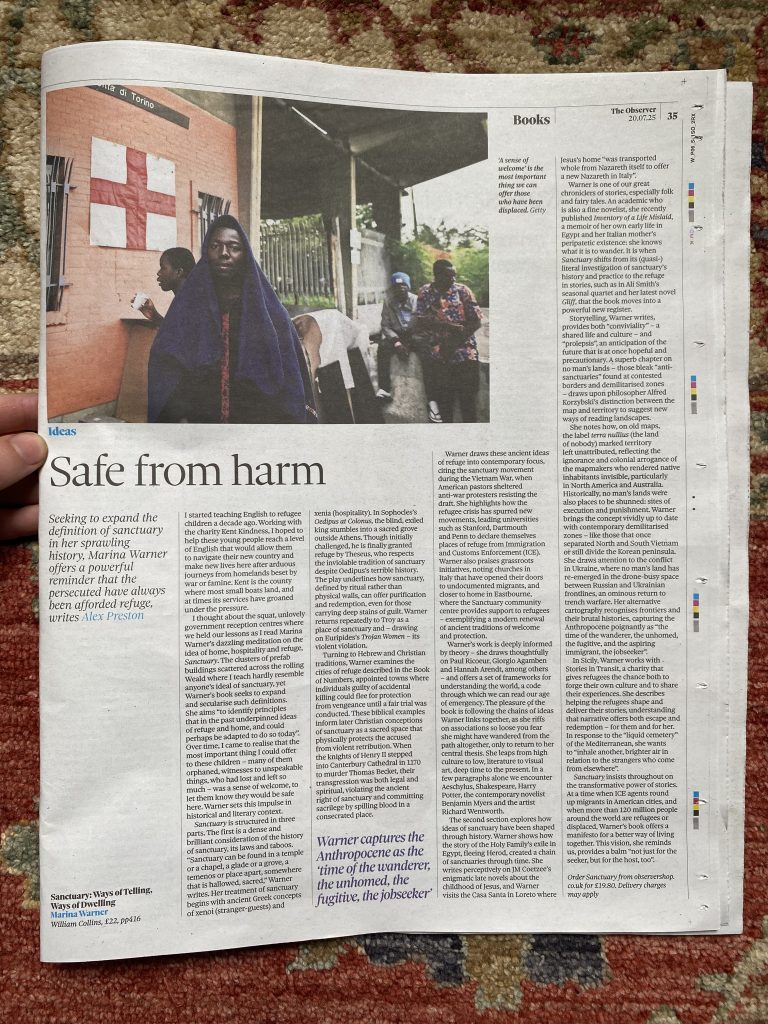
July 20 2025, ‘Safe from Harm’, Alex Preston, The Observer, read here.
Alex Preston reviewed Sanctuary: Ways of Telling, Ways of Dwelling for The Observer, which he writes is a ‘dazzling meditation on the idea of home, hospitality and refuge’. Preston also writes: ‘The pleasure of the book is following the chains of ideas Warner links together, as she riffs on associations so loose you fear she might have wandered from the path altogether, only to return to her central thesis. She leaps from high culture to low, literature to visual art, deep time to the present.’
8 August 2025, Church Times ‘Book review: Sanctuary: Ways of telling, ways of dwelling by Marina Warner’, Katherine Harvey, online and available here.
Harvey writes that Marina, in particular her work on Stories in Transit, ‘offer a glimmer of hope in our increasingly unsettled world’.
August 22, 2025, TLS (No.6386) Review of Sanctuary by Alberto Manguel
Marina’s book Sanctuary: Ways of Telling, Ways of Dwelling was reviewed in the 22 Aug issue of the TLS, in a piece titled ‘Refuge, lair and inner sanctum: A history and study of the concept of sanctuary’, by Alberto Manguel. He writes: ‘she is rigorous in her research and punctilious in her bibliographical backing […] there is a playful Ariel behind her scholarly Prospero’; ‘Warner weaves her argument by passing seamlessly from Gilgamesh to video performances, from Kalīla and Dimna to Harry Potter, and somehow it all makes sense, even if sometimes the point of the story is just the story.’ ; ‘Sanctuary is an enlightening gift’.
Read online or in print here.
9 September 2025, Marina Warner: ‘I wouldn’t dare write Indigo now’, Prospect Magazine
Franklin Nelson visited Marina and wrote a short piece about her, Sanctuary and the upcoming exhibition The Shelter of Stories, coming soon to Compton Verney. Read the article here.
Sanctuary events
Upcoming:
5 May 2026, ‘The Country of Words: Sanctuary in the Classroom’, Birkbeck Arts Week 2026
Julia Bell’s new book, Between the Lines, explores the creative writing class from personal experience of its dynamics. Marina Warner’s recent study, Sanctuary: Ways of Telling, Ways of Dwelling, proposes that imaginative story-making can build home and belonging. In the current climate of exacerbated divisiveness, anxiety about self and hostility towards others, Julia Bell and Marina Warner will hold a conversation followed by a workshop to explore the role that words and stories, writing and narrating, can play.
More information and booking available
here
Past:
July 11, 2025, Enchanting Wor(l)ds: The Works of Marina Warner, Centre for Comparative Literature (Goldsmiths) Room 349, Senate House, Malet Street, London, WC1E 7HU
This conference is a celebration of Marina’s work over her lifetime, organised by Lucia Boldrini, Marie-Claude Canova-Green, Clare Finburgh Delijani and Isobel Hurst. The whole day promises a wealth of brilliant talks and presentations, including the keynote – an abecedary of Marina! – by Philip Terry. Marina will be in conversation towards the end of the day, with Clare Finburgh Delijani and Natalie Katsou. Following this is the book launch and reception. Find out more about the programme here and more general information (registration etc) available here!
June 13, 2025: Maps of home: Imagining sanctuary now (College of Sanctuary Lecture), Mansfield College, Oxford, 5.30-6.30pm
Acclaimed historian, mythographer, art critic and novelist Marina Warner reflects on the idea of home, and how we can imagine sanctuary today.
This biennial lecture highlights Mansfield College’s status as a College of Sanctuary under the UK Universities of Sanctuary scheme. Learn more about this here.
Register to attend here
English historian, mythographer, and author of Inventory of A Life Mislaid, Marina Warner will discuss her latest book about sanctuary: what it means for people in desperate situations today, and what refuge and displacement has meant for people throughout history, and the canons of literature and myth.
This event is part of an afternoon exploring Spirits, Salons and Sanctuary in the church of St Leonards through new books by poet and translator Philip Terry, poet and novelist Clare Pollard and cultural historian, mythographer and writer Marina Warner. These events are kindly supported by The Bean Trust.
Register to attend here
July 9 2024: LRB event – Marina in conversation with James Butler, 7pm, London Review Bookshop, 14 Bury Pl London WC1A 2JL, Tickets: £10
Marina discusses her new book on the ancient right of sanctuary and its meaning in the modern world with James Butler at the London Review Bookshop (14 Bury Pl London WC1A 2JL) at 7pm on 9 July 2025. Listen back here.
July 10 2025: Refugee Tales 2025: Festival of Walking, Panel Discussion – What Are the Longterm Impacts of Detention? William Patten School, Stoke Newington, Join the walk to attend!
July 15, 2025, Talk for The Folk Society, ‘How to Create Sanctuary Now?’, 19:00 BST, tickets £6.00 (£4 for members with promo code)
Get your tickets here!
For the last online talk before our summer break we're delighted to be welcoming Professor Dame Marina Warner @marinawarner.bsky.social for her talk 'How to Create Sanctuary Now?’ Tuesday 15 July at 19:00 BST, tickets £6.00 (£4 for members with promo code) www.eventbrite.co.uk/e/how-to-cre…
— The Folklore Society (@folkloresociety.bsky.social) 2025-07-08T20:39:23.005Z
[POSTPONED] August 10, 2025, ‘Marina Warner: A Place of Sanctuary’, Edinburgh International Book Festival, 2.45-3.45pm, Spiegeltent, Tickets here
What is ‘sanctuary’? Is it a sacred place where travellers and refugees might find safety and solace? Or is it a homeland to be shuttered and defended against incomers from the outside world? Exploring the concept throughout history and myth in her new book Sanctuary, prolific critic, cultural historian, and Booker Prize-shortlisted novelist Marina Warner joins us today to ask profound and urgent questions about the right to safety, home, freedom of movement, and peace. Chaired by Esa Aldegheri.
August 21, 2025, Author’s Club Lunch event, 12.30pm, National Liberal Club, 1 Whitehall Place, London SW1A 2HE
What does sanctuary mean today? Drawing on a lifetime of engagement with literature, myth, history and tradition from different cultures, Marina Warner’s Sanctuary is an ambitious attempt to grapple with the sharpest questions that we are facing in today’s world of global turmoil.
More information here.
19 September 2025, New York Institute for the Humanities, online event
Marina will be joining NYIH friends and fellows online to speak about
Sanctuary: Ways of Telling, Ways of Dwelling. Learn more about NYIH
here.
11 October 2025, Cliveden Book Festival
5 November 2025, Bridport Literary Festival, The Bull Ballroom, 5pm, in conversation with Prue Keely, tickets here
Sanctuary is an ancient right. In the classical world, it offered immunity to fugitives from justice; in medieval Europe it extended a reprieve to all who sought it in a church or holy site. But what does sanctuary mean in today’s world? With the growth of nationalism and individualism, the concept has drifted away from a place of openness and welcome towards privacy: home as sanctuaries against strangers, migrants, incomers. Marina Warner navigates the principles that underpin the tradition of sanctuary and argues that storytelling offers a salve, a route to mutual understanding.
Thursday 27 November 2025, ‘Sanctuary, Safety, and Sacrilege, 15:30 – 17:00, All Souls Criminology Seminar Series, Wharton Room (All Souls College) + online
Sanctuary offered safety to fugitives, regardless of their guilt or innocence, for a certain period – usually forty days (a quarantine). It held as a legal right until Henry VIII began its abolition. But the memory of it survives in the form of Sanctuary Cities, Universities and Colleges of Sanctuary. However, the principle of offering safety to refugees, forced migrants and arrivants in general has come under extreme strain, to say the least, from anti-immigrant policies, fuelled by some vocal elements of public opinion. Meanwhile the concept of sanctuary itself has increasingly shifted from a place of openness to a private stronghold, from a commons of equality to a bastion of individual rights.
Marina will look at the history of sanctuary, the significance of its present flouting and abandonment, and its potential reconfiguration to meet exacerbated current conditions.
Register your attendance here
Thursday 4 December 2025, Marina Warner: In Conversation & Book Signing, Compton Verney (Warwickshire, CV35 9HZ), 11.30-1pm
Marina will be in conversation with curator Oli McCall, discussing the exhibition they have been working on together, The Shelter of Stories, which is on until 22 February 2026. They will be sharing the ideas and inspirations behind the exhibition, along with Marina’s recent book, Sanctuary: Ways of Telling, Ways of Dwelling. Book your tickets to join here.
(SOLD OUT) 21 February 2026, Faversham Literary Festival, The Old Brewery Store, 3-4pm
Marina will be in conversation with Daniel Hahn for the Faversham Literary Festival on Saturday 21 February, discussing Sanctuary: Ways of Telling, Ways of Dwelling. More information available here.
19 March 2026, Writer’s Lunch, Oxford and Cambridge Club
30 March 2026, EXPeditions Book Club #2: Marina Warner’s “Sanctuary: Ways of Telling, Ways of Dwelling”, 7 – 8pm (online)
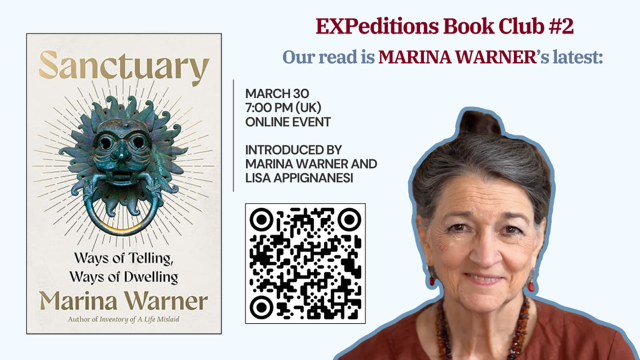
Marina Warner will join us and answer your questions about her latest book SANCTUARY, in conversation with Lisa Appignanesi.
Sanctuary is an ancient right. It both promises and is a haven. It is a place of refuge and of freedom from harm.
With brilliance and erudition, the distinguished cultural historian Marina Warner teases out the principles that govern the ancient tradition of sanctuary. Crucially, she also asks, could a revived practice of sanctuary today offer security and a home for the displaced. This is a groundbreaking book which explores the principles that underpin the tradition of ‘sanctuary’. It was written alongside work with the Stories in Transit project bringing young refugees together with artists, writers and musicians in the UK and in Sicily to invent or reimagine stories and perform them.
Warner reflects on the ways stories address the worst experiences of humanity, and argues that the act of storytelling offers a salve, a route to a site of mutual interaction and understanding, a new place of belonging and conviviality.
You can buy the book on this link via Bookshop.org.
Register to join on 30 March, here.
17 April 2026, Barnsbury Book Festival, St Andrew’s Church, N1 1BQ, 3.30 – 4.30pm
Marina Warner’s numerous books, stories and essays explore myth, storytelling, history and society. In Sanctuary she investigates ideas of refuge, hospitality and belonging, and how storytelling helps people endure and understand crisis. She will be discussing the changing concepts of sanctuary with Dr Alex Pryce, Senior Tutor of St Edmund’s College, Cambridge.
More information about the Barnsbury Book Festival here
4 May 2026, EXPeditions: Interview with Lisa Appignanesi
Listen to Marina in conversation with Lisa Appignanesi about Sanctuary: Ways of Telling, Ways of Dwelling:
Marina Warner takes the idea of Sanctuary into an ethical and imaginative register and consider it as a set of images, places, stories, as well as sometimes a very property of stories. Narrative itself is a dwelling.
Myths fairy tales pose vital questions about central aspects of existence and, regenerated in new re stories held in common – thought experiments. Ways of telling shape ways of dwelling alongside one another.
Available here.

Marina has contributed an interview with Dine Diallo, of Giocherenda, to Crossings: Migrant Knowledges, Migrant Forms, a book emerging from a three day gathering in September 2019. The CRASSH project (Migrant knowledge, early modern and beyond) was led by Subha Mukherji, who collaborated with Natalya Din-Kariuki and Rowan Williams to edit the book. It is due to be published in Spring 2025. We will update this when there is a firm date!
The publication has a wonderful cast of contributors. The full list is here:
Faraj Alnasser, Aditi Anand, Anupam Basu, Clelia Bartoli, Yota Batsaki, Gillian Beer, Annabel Brett, Anthony Vahni Capildeo, Valentina Castagna, Amit Chaudhuri, Supriya Chaudhuri, Nadina Christopoulou, Brian Cummings, Rosita D’Amora, Edmund de Waal, Olga Demetriou, Saifoudiny (Dine) Diallo, Valerie Forman, John Gallagher, Jonathan Gil Harris, Simon Goldhill, Mina Gorji, Akid Hassan, Gabriel Josipovici, Dragana Jurišić, Bhanu Kapil, Issam Kourbaj, TM Krishna, Angela Leighton, Sue McAlpine, Joe Murphy, Yousif M. Qasmiyeh, Joe Robertson, Claudia Roden, Mohamed Sarrar, Efi Savvides, Regina Schwartz, Rachel Spence, A.E. Stallings, Susan Stockwell, Carla Suthren, Marina Warner, Clair Wills, Pip Williams
Crossings: Migrant Knowledges, Migrant Forms brings together activists, artists, scholars, and migrants with diverse histories to explore what the experience of migration does with, and to, knowledge, and how its own ways of knowing find expressive form. As the volume’s authors think about physical and imaginative crossings, and the traversals and transactions of knowledge they entail, the book itself crosses and complicates disciplinary and formal boundaries and the barriers between critical and creative intervention. Crucially, it brings together voices and forms emerging out of the experience of dislocation with responses to the encounters it generates.
The volume’s discussions begin in the early modern world, and move freely across periods to dwell on the urgent experience of migrancy in our own times, while also responding to an urgent need to connect the local with the global experience of migrant knowledge and migrant aesthetics. Crossings stakes the claim that creative art, backed by humanities-based thinking, can meet the imaginative and ethical demands that the unknowable reality of mass displacement places on us, in a way that governments, institutions, and public discourse have calamitously failed to do. But aesthetic practice itself needs to be re-positioned if it is to rise to these political and human challenges, negotiating the points of friction between its own predilections and the matter of migration.
Crossings offers “migrant forms” – forms that cross boundaries naturally and are “knowing” about crossings – and offers as the means of this imaginative re-orientation a tool for activating a radical alternative to economic models of social benefit. Crossings takes its place in an emergent ecology of migrant forms, both speaking to and participating in that ecology.
Crossings: Migrant Knowledges, Migrant Forms
When migrants move, they take things with them – memories, feelings, thoughts, things – an entire sensorium of experiences. There are profound losses, but there also gains. This beautiful cornucopia of essays, stories, poems, conversations, objects, and images lets us see the vital ways in which the world is unmade and remade by human migration. Crossings highlights the great variety of conditions under which people move and have moved in the past – some of them harrowing – and shows us what happens next. The works in this collection explore the possibility that art can, in Subha Mukherji’s words, “replenish refuge,” be a “kind of asylum.” This is a wonderfully crafted, inspiring assemblage of work by writers, artists, and scholars. Essential reading for all of us who wish to understand the condition of migrancy in the past and in the present – it gives us hope for a better future.
~ Josephine McDonagh, author of Literature in a Time of Migration: British Fiction and the Movement of People, 1815-1876
“The world found nothing sacred in the abstract nakedness of being human,” Hannah Arendt wrote of the reception that greeted refugees and migrants in the 1940s. Patently, it still does not. And yet, for all the grim cruelty of our current anti-migrant age, there is something else – a moving world, and a moving earth, rich, challenging, and constant. This beautiful and capacious collection of essays, artworks, interventions, and conversations brings two existences into stark and stunning relief. On the one hand, there is the arid monotony of push-backs, populist bilge, inchoate rage, and political cynicism. On the other, there is “migrant knowledge,” a way of knowing, being, and imagining that is open – that has to be open – to the reality of a shared, plural Earth. Like its authors and themes, this book crosses nations, forms, and disciplines. A landmark text at a moment when a new conversation about what it means to inhabit this land together is so desperately needed.
~ Lyndsey Stonebridge, author of Placeless People: Writing, Rights, and Refugees
Crossings is moving, thought-provoking, and deeply original. This dazzlingly rich and genre-bending volume feels like wandering through a brilliantly curated museum or like having a series of urgent conversations with friends from all over the world. It is an exploration of migrant knowledge (as well as migrant suffering) from many angles, some poetic, some historical, some culinary, some political, all deeply current (or what Subha Mukherji calls “gut-wrenchingly present”). Crossings is essential reading for anyone who wants to explore some of what we all owe to migration: people, things, ideas, art, recipes, songs, languages and libraries. It moves deftly between big ambitious themes – how do cultures accommodate human difference? how can the displaced ever find home? – to small, telling details such as spoons in Syria made from bombs or the comfort of a mother’s jam. It centers and celebrates the voices of migrants themselves without glossing over the violent truth that, as Rowan Williams writes, not everyone’s voice gets heard and “not everyone survives the passage.”
~ Bee Wilson, author of The Secret of Cooking
This remarkable collection of essays and dialogues illustrates the vibrancy and urgency of our emerging awarenesses of migrant knowledges and migrant forms. Through this lens, a truly diverse range of perspectives are brought to bear on such recognizable humanistic topoi as reflection, empathy, memory, and imagination – all of which are bound to the human experience of place. As the collection demonstrates, the mobility of place – not just persons or groups – is what allows thought itself to be flexible, dynamic, and occasionally true.
~ Michael Witmore, author of Shakesperean Metaphysics

What happened to time during the Coronavirus pandemic lockdowns? Acclaimed novelist and essayist Marina Warner recounts how strangely her days and weeks passed, in this highly personal account of a response to lockdown in which she delves into her experience of Catholic convent schools for some clues as to how each day might be marked as significant. She discusses missals, almanacs, Roman and Revolutionary calendars, developing her thoughts into what amounts almost to a manifesto – for a new way of rendering each day different, memorable, human. Her text is accompanied by a further response to lockdown, by the Greek photographer Dimitris Kleanthis, whose haunting images somehow make visible the suspension-and-acceleration of time experienced by so many, while also hinting at how, to the eye that is acute enough, there may always be an event taking place.
Published by Sylph Editions, this elegant book is part of ‘The Cahiers Series’ made in collaboration with The American University of Paris: ‘The goal of this series is to make available new explorations in writing, in translating, and in the areas linking these two activities.’ Find out more about the series here. Buy a copy of this beautiful book (£14) on Sylph Editions here!
Since Temporale was published, it has been featured in various publications, online and in print.
17 March – TLS, ‘Dish delish’, Temporale feature
In the TLS column by M. C., Marina’s latest book Temporale is mentioned, with a photograph from the publication by Dimitris Kleanthis shown alongside. M.C. writes
We admire the choice of images such as the portal station reclaimed by nature, pictures above, perhaps a little more because they do not exactly illustrate the essay they accompany; rather, they “partner” them. […] And as Kleanthis’s photos are to Temporale, so Temporale is to Warner’s recent memoir Inventory of a Life Mislaid, resuming a life story from a different angel. May post-lockdown literature bring about more such partnerships.
14 April – Temporale excerpt, The New York Review
This edited excerpt from Marina’s book, Temporale is accompanied by historical images of almanacs and timekeepers, as well as part of Francesco del Cossa’s frescoes that make up the months in Palazzo Schifanoia!
25 April – Temporale excerpt in Book Post‘s most recent mail-out, along with a review
Book Post have featured Marina’s latest publication Temporale in their 25 April Diary, along with a review of the work, giving some background on the Cahiers series:
Temporale reflects on ways to cultivate in modern life the benefits of the marking of time in ancient calendars. The Cahiers series, a veritable who’s who of contemporary literature and art […] Dan Gunn teamed up with designer and Sylph Editions founder Ornan Rotem to create a series of impeccably produced, hand-bound chapbooks of around forty pages, combining art and literature. In 2013 he was joined by scholar and critic Daniel Medin. Find out more about […] the confluence of circumstances that nourished [Dan Gunn’s] eclectic career in this interview—in Music & Literature—with Lydia Davis.
21 September, ‘Temporale’ – Event celebrating Marina Warner’s book Temporale, #39 in the Cahiers Series, 6.30pm, 6, rue du Colonel Combes, 75007 Paris

The Center for Writers and Translators celebrated their most recent publication with Sylph Editions by Marina, Temporale, the 39th issue of the Cahiers series. Temporale addresses ‘What happened to time during the Coronavirus pandemic?’, as Marina recounts how strangely her days and weeks passed, in this highly personal account of a response to lockdown.
Review by Ruth Padel in LMH Brown Book 2023
Read the review of Temporale (pp.111-112) here, or see below. Padel writes that Temporale is a ‘richly associative and imaginative essay […] a highly personal but wonderfully erudite response to that bizarre time we all shared alone. […] Read Warner’s essay and marvel at how the ways we measure time recharge our subjective experience of it through our life’